
When most property owners, Realtors, or property managers in Santa Barbara hear the word "mold," they picture surface discoloration, a musty bathroom, or damp drywall. But there is a far more aggressive, wood-destroying organism quietly at work across coastal Southern California: Meruliporia incrassata (commonly known as Poria incrassata, or the "house-eating fungus").
Unlike common indoor molds that simply feed on surface organic dust or wet sheetrock, Poria is a structural wood-rot fungus. It possesses a unique biological feature—root-like water transport cords called rhizomorphs—that allow it to draw moisture from damp crawlspace soil or a plumbing leak and transport it several feet into bone-dry structural framing.
Left unchecked, Poria can destroy load-bearing joists, subfloors, and wall studs in a matter of months.
Recently, our team at Adaptive Environmental Consulting (AEC) reviewed an actual real estate transaction at an upscale Santa Barbara home in Santa Barbara—a $3.1M property built in 1964—that perfectly illustrates how Poria develops, how it is frequently mismanaged, and why independent environmental testing is essential to protect your property and your investment.
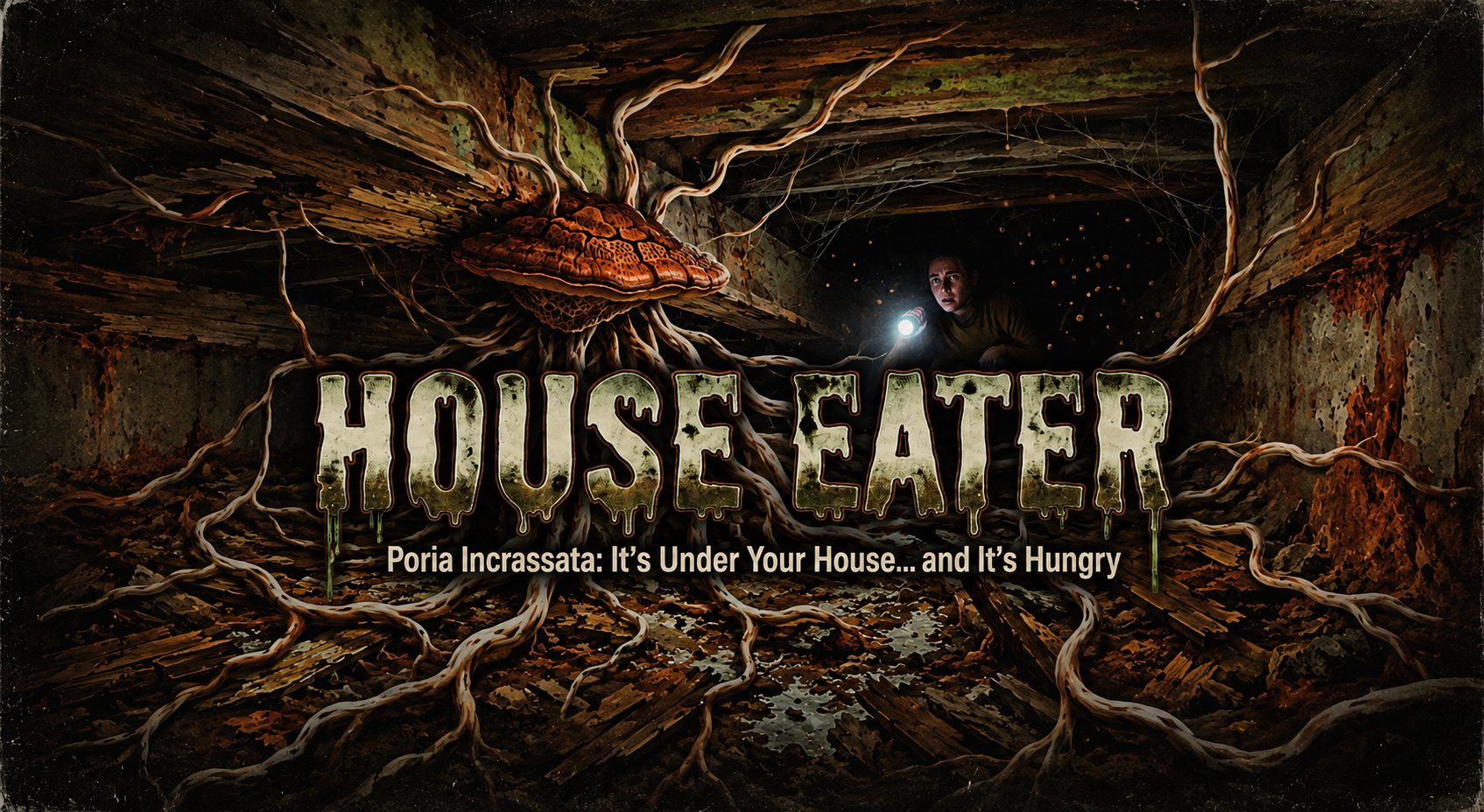
A Real Santa Barbara Case Study: Vital Steps to Reducing / Eliminating Poria - The House Eating Organism
Earlier this year, an upscale Santa Barbara home uncovered a mature, flat, shelf-like fruiting body—a classic sign of active Poria—growing along crawlspace framing near the foundation line. The primary catalyst was a long-term water leak from a master bathroom shower pan upstairs that was feeding this house-eating organism, allowing unrestricted access to the lumber under the home for who knows how long.
Remediation was performed, and over $20,000 was spent between remediation contractors and rebuild estimates. However, a technical review of the paper trail revealed critical gaps that leave the property exposed to ongoing environmental and structural liability:
Surface "Cleaning" vs. True Structural Excision: The remediation invoice billed 120 man-hours for sanding, wire brushing, and surface wiping of affected framing. Poria rots timber internally. Industry standards (IICRC S520) require physically cutting out compromised framing plus a minimum 2-foot safety margin of sound wood. Sanding wood leaves live fungal hyphae intact inside the timber.
Missing Substratum & Soil Abatement: Although soil removal was in the initial contract proposal, no soil excavation or disposal appeared on the final invoice. If rhizomorph cords remain in damp crawlspace soil, the root network remains live.
Unverified Structural Repairs: The construction estimate explicitly stated subfloor and framing repairs were excluded pending exposure, yet no final invoice or permit records were provided to prove structural timbers were ever replaced.
No Independent Clearance: The file contained no Post-Remediation Clearance (PRC) report from an independent third-party environmental consultant certifying the work was successful.
This situation happens far too often when remediation contractors are allowed to "write their own report cards."
Red Flags & Things to Look For
Santa Barbara’s coastal microclimate—characterized by high marine humidity, coastal fog, and unconditioned mid-century crawlspaces—creates the ideal environment for Poria.
Watch for these warning signs in your home, rental portfolio, or upcoming listing:
Fruiting Bodies: Flat, pancake-like or shelf-like mushrooms growing on baseboards, subfloors, or crawlspace timbers (ranging in color from dirty white/yellow to dark brown).
Rhizomorph Cords: Vine-like, root-like tendrils (white when young, dark/brittle when mature) clinging to foundation walls, soil, or framing timbers.
Cubical Dark Rot: Framing wood that appears scorched, dark brown, or breaks apart into brittle, charcoal-like cubes.
Persistent Excess Moisture: Standing water in crawlspaces, leaking shower pans, failing stucco seals, or wood moisture content (WMC) reading consistently above 19%.
How Adaptive Environmental Consulting Protects You
At Adaptive Environmental Consulting, we do not perform mold or rot removal. We provide 100% unbiased, conflict-free environmental testing, moisture mapping, and scope-of-work protocols. Because we have no financial interest in selling you expensive remediation services, our sole objective is providing accurate, scientific data to keep your property safe and dry.
Here is how AEC helps at every stage of the process:
1. If Nobody Has Assessed the Property Yet (Pre-Remediation)
If you suspect Poria, notice unusual floor sagging, or find hidden moisture under a bathroom:
Targeted Moisture Mapping & Crawlspace Audits: We deploy advanced pin-type wood moisture meters and infrared thermal imaging to identify hidden leaks and map exact wood moisture content (WMC).
Field & Lab Identification: We perform direct sampling (tape lifts, bulk wood samples, or qPCR DNA testing) to identify active wood-decay organisms and monitor secondary water-damage indicators (Aspergillus, Chaetomium).
Custom Remediation Protocols: We write a detailed, step-by-step Scope of Work for your contractor to follow. This ensures contractors cut out the appropriate safety margins, treat the soil properly, and fix the root moisture problem—saving you thousands in unnecessary or improper demolition.
2. If Remediation Work Has Already Been Completed
If a seller claims a past moisture or Poria issue was "fixed" (like the Manitou Road property):
Document Audits: We review past contractor invoices, scopes of work, and repair bids to identify hidden gaps or missed steps.
Post-Remediation Clearance (PRC) Testing: We conduct rigorous physical crawlspace inspections, cavity air sampling, and moisture verification.
Certified Verification: We provide an official, third-party Post-Remediation Clearance report that gives property owners, buyers, real estate agents, and mortgage underwriters true peace of mind that the organism has been completely eradicated.
3. Controlling the Root Cause: Excess Moisture
Poria cannot feed, transport water, or survive without an active moisture source. AEC helps landlords, Realtors, and homeowners identify and eliminate excess sub-structure humidity, ground vapor intrusion, and plumbing failures before they turn into catastrophic structural rot.
The Bottom Line for Santa Barbara Real Estate
Poria incrassata is completely manageable—if it is properly diagnosed, physically excised, and independently verified.
Whether you are preparing a listing, managing a multi-family property, or navigating an escrow in Santa Barbara County, never accept surface-level fixes for structural rot. Start with an independent assessment to get the facts, protect your equity, and ensure the work is done right the first time.
Need an independent environmental assessment, moisture audit, or post-remediation clearance in Santa Barbara County?
Contact Adaptive Environmental Consulting today at (805) 741-8143 or visit us at adaptivenv.com.