
California's Central Coast is well known for its clean marine air and beautiful coastal environment. However, indoor environments across Santa Barbara, San Luis Obispo, Ventura, Los Angeles, and Kern Counties can still face unique air quality challenges. Because people spend a large portion of their time indoors, maintaining clean indoor air is important for both occupant health and property integrity.
Indoor air quality can be affected by outdoor conditions, moisture, building materials, ventilation, and other factors. Understanding these potential issues can help property owners identify problems early and take appropriate action.
Residents and property owners throughout California's Central Coast can learn more about professional environmental testing through Adaptive Environmental Consulting's Indoor Air Quality Testing page.
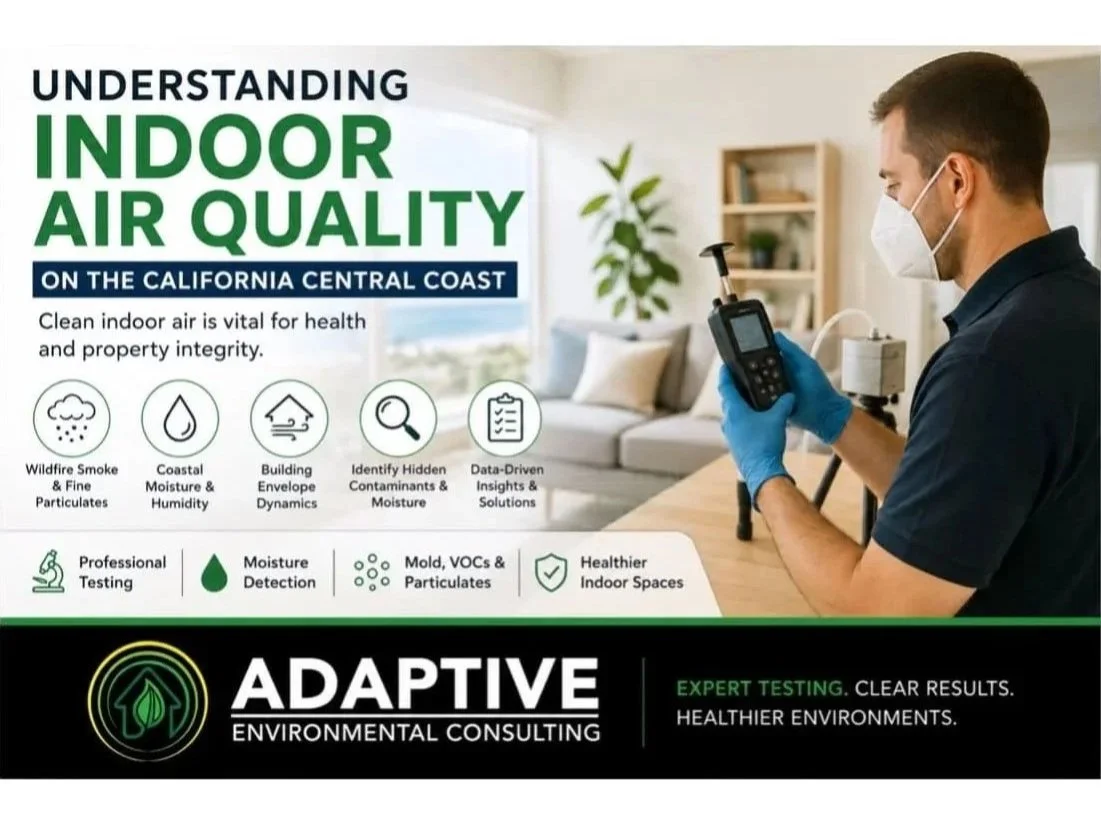
Environmental IAQ Drivers for Central Coast Properties
Central Coast residential and commercial properties face different environmental pressures throughout the year. Some of the most common factors that can affect indoor air quality include:
Wildfire Smoke & Fine Particulates
Seasonal wildfires can affect air quality throughout California. Even when windows and doors are closed, wildfire smoke can enter buildings through small openings, ventilation systems, and other parts of the building envelope.
Smoke can introduce fine particulate matter, including PM2.5, along with other combustion by-products into indoor spaces. These particles can remain suspended in the air or settle on indoor surfaces, making indoor air quality assessment important after significant smoke exposure.
Coastal Microclimates & Moisture
The Central Coast's coastal environment, including marine fog and periods of higher relative humidity, can increase moisture levels in and around buildings. When moisture remains trapped in building materials, it can create favorable conditions for fungal growth.
Moisture problems are not always visible. Mold and other biological growth can develop behind walls, beneath flooring, or within other porous materials when moisture intrusion goes undetected.
Building Envelope Dynamics
The age and design of a building can also influence indoor air quality.
Older coastal properties may experience ventilation problems or deferred maintenance that allows pollutants and moisture-related issues to remain unnoticed. Newer, highly energy-efficient buildings can have a different challenge. If fresh-air circulation is limited, indoor contaminants such as volatile organic compounds (VOCs), chemical off-gassing, and biological contaminants may become trapped inside.
For these reasons, evaluating the condition of the building and its indoor environment can be an important part of identifying potential air quality concerns.
When to Schedule a Professional IAQ Assessment
Regular cleaning and routine HVAC filter replacement are important steps for maintaining a healthy indoor environment. However, these measures cannot identify every indoor air quality problem.
They may not reveal hidden biological contaminants, chemical off-gassing, or concealed moisture intrusion. A professional indoor air quality assessment can provide objective information about the indoor environment using specialized diagnostic equipment and, when appropriate, laboratory analysis.
A professional assessment can help determine whether further investigation or corrective action is needed.
Call or text our Field Technician and Managing Branch Partner in Central Coast, California at (805) 741-8143 with questions or to schedule an appointment!
Key Benefits of a Professional Assessment
A professional indoor air quality assessment can help:
Identify elevated fungal spore levels through indoor and outdoor baseline control sampling.
Pinpoint hidden moisture intrusion using non-destructive moisture mapping.
Evaluate VOC off-gassing, bioaerosols, and airborne particulate loads.
Identify potential environmental concerns that may not be visible during routine cleaning or maintenance.
Provide clear, actionable recommendations to address environmental issues before they develop into more costly structural problems.
Early identification can help property owners better understand the condition of their indoor environment and determine the appropriate next steps.
For location-specific environmental services, visit our Central Coast California page.
Frequently Asked Questions (FAQs)
How Often Should Indoor Air Quality Testing Be Conducted?
Indoor air quality testing may be recommended when occupants experience persistent or unexplained respiratory symptoms, following water intrusion events, during real estate transactions, or after major structural remodeling.
The appropriate timing and scope of testing will depend on the property's condition and the reason for the assessment.
What Parameters Are Evaluated During an IAQ Inspection?
The parameters evaluated can vary depending on the scope of the investigation. An assessment may include airborne mold spore concentrations, relative humidity, temperature, fine particulate counts, VOC screening, and physical moisture mapping of porous building materials.
Additional testing may be recommended when initial findings indicate a specific environmental concern.
Can Air Quality Testing Pinpoint the Exact Source of a Problem?
Air quality testing can help identify and isolate potential contamination concerns, but it is most effective when combined with a thorough inspection of the property.
Visual inspections, thermal imaging, moisture mapping, and air or surface sampling can work together to help identify potential sources and establish appropriate remediation protocols.
Maintaining good indoor air quality requires more than routine cleaning. Understanding the environmental conditions affecting a property can help Central Coast property owners identify potential concerns and address them before they become larger problems.
